B Corp or Benefit Corporation? Here's the Difference (and Why It Matters)
Godspeed: good fortune; success (used as a wish to a person starting on a journey, a new venture, etc.)
Welcome back to the world of work – hope you enjoyed your long weekend.
Last week, I wrote about public benefit corporations that aren’t distributing their benefit reports to the public.
Since there’s some confusion as to the difference between benefit corporations and B Corps, I thought I’d follow up with an explainer of sorts.
While I’ll focus primarily on benefit corporations, you can’t talk about one of the leading business models for social impact without distinguishing it from one the other “B” – so that’s where we’ll start.
Benefit Corporations and B Corps are like Kissing Cousins
The two are close relatives, call them kissing cousins if you’d like, but they definitely aren't identical twins.
B Corp is a certification, while a benefit corporation is a legal structure.
To become certified as a B Corporation, aka B Corp, companies go through a voluntary and rigorous assessment of their environmental and social practices by the nonprofit B Lab. To certify as a B Corp, your company must pass specific, mandatory requirements covering seven impact topics including climate action, human rights, and fair work.
I’ll follow up soon with a post focusing on the nonprofit B Lab – the certifying body for B Corps – as this year is its 20th anniversary.
Benefit Corporations (in some states called “Public Benefit Corporations”) are designed to legally balance a company's ability to create social impact alongside financial profit.
This designation comes with a new responsibility—benefit corporations are legally required to demonstrate the specific public benefits they are claiming to create.
Three Basic Benefit Requirements
Three general requirements of a benefit corporation are consistent in most states:
- The company must define a specific public benefit it will seek to create for stakeholders in addition to profit for shareholders.
- It will provide shareholders with an annual benefit report detailing the ways it pursued and delivered a public benefit—and publish the annual report on the public portion of its website.
- It must use a third-party standard or verification service to assess its social or environmental performance in pursuit of its stated public benefit.
Of note: Delaware, which has more benefit corporations than any other state, requires benefit reports to be produced biannually, and companies incorporated there are only required to distribute them to their board of directors – not to the broader public. This creates a potential "transparency gap," as it excludes the public from the benefit corporation's impact reporting.
Can a B Corp also be a Benefit Corporation?
And the answer is that question is – cue the confusion – yes! A recent change to the B Corp certification process requires that companies become a benefit corporation (or legal equivalent) prior to certification if they operate in a state with this legal status.
On the other hand, becoming a benefit corporation does not require getting certified as a B Corp.
Got that?
The Benefit Corporation Model is Growing Globally
The first state to approve Benefit Corporation legislation was Maryland in 2010. Shout-out to Big Bad Wolf, a pet shop that became Maryland’s first public benefit corporation and thus the first in the world as well (Woof!).
Today, 41 states, the District of Columbia, and the territory of Puerto Rico have adopted this legislation. The community of benefit corporations has grown from that cool little pet shop in Maryland to more than 10,000 companies in the U.S.
While many of these companies are small and mid-sized businesses, the community also includes well known consumer brands and public companies. The crowdfunding site Kickstarter and outdoor retailer Patagonia are both Benefit Corporations, as are tech giants Anthropic, Bluesky, Mark Cuban Cost Plus Drugs, and OpenAI.
Just last week, I wrote about those last four benefit corporations and their lack of public reporting.
This model of stakeholder capitalism is being embraced around the world. Similar legal business structures are now recognized in Italy (2016), Colombia (2018), Ecuador (2019), the province of British Columbia, Canada (2019), France (2019), Peru (2020), Rwanda (2021), Uruguay (2021), Spain (2022), Panama (2022 – framework enacted but implementation still pending).
Active legislative discussions are also underway in Argentina, Brazil, Chile, and several EU member states
Reap the Benefits of Becoming a Benefit Corporation
If your company is in a state with the option to become a Benefit Corporation, give it due consideration and remember: With this legal designation, you are inviting the public into your business. It’s a powerful declaration to the world about the intent of your company and the difference you intend to make through your business practices. Adopt it honestly and live up to its core tenets, not the least of which is publicly reporting your impact to stakeholders.
Looking once again at you, Anthropic, Bluesky, Mark Cuban Cost Plus Drugs, and OpenAI. 🤔
Godspeed, friends.
Russ
🌏 Think About It
"You are not Atlas carrying the world on your shoulder. It is good to remember that the planet is carrying you." Vandana Shiva
"I Am Not The Weirdo In The Forest Anymore"
So said artist Thomas Danbo when quoted by the New York Times about his artwork of giant forest creatures made from trash.
Specifically, he said, "I am not the weirdo in the forest anymore. What I have created is interesting and cool to the people who run the cultural world."
It's a great read, whether you're into recycling or not. You can can check it out here in this gift article link.

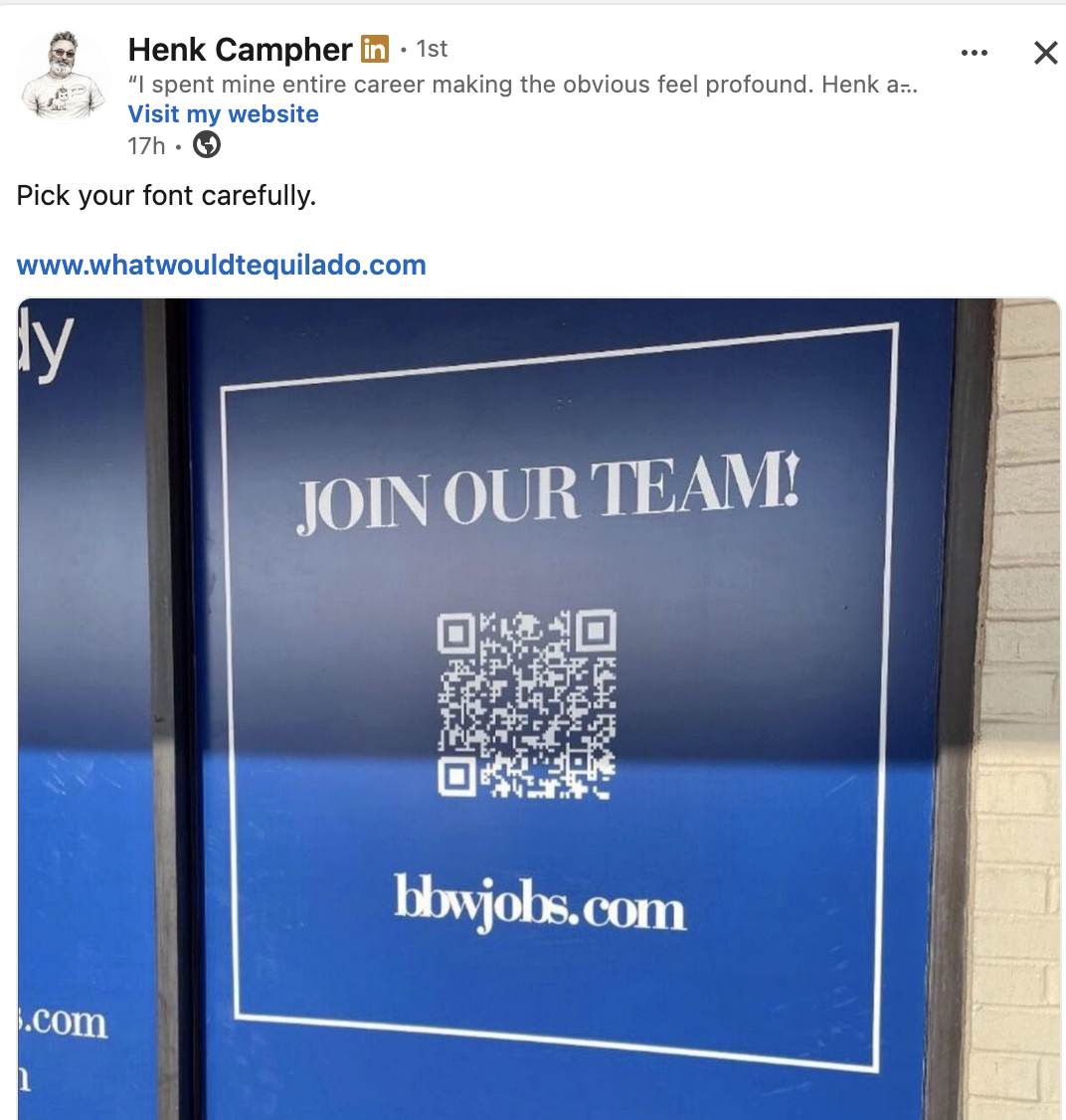
Pick Your Font Carefully
Henk Campher surfaced this typeface example on LinkedIn, though I'm not certain all the font really needed was a light assist from our friends in the Kerning Department. What do you think?