
How a Teacher's Challenge Led Me to a Movement Now 20 Years Strong
Godspeed: good fortune; success (used as a wish to a person starting on a journey, a new venture, etc.)
Fifteen years ago this summer, my son’s grade schoolteacher, Lisa Fisher, collared me after a school event and said, “Russ Stoddard, you have got to become a B Corp!” Apparently, she’d fell in league with some crazy folks who had a different approach to capitalism, that being the team at B Lab, the nonprofit certifying body for B Corps, and she thought my branding agency would be the perfect candidate for this community of companies using business for good.
(Wow. That last one is a long sentence. Should I have truncated it? Nah, let the clauses and commas roll.)
And when “Ms. Fish” talks, you listen, so I went back to the office and started the process of certification that same afternoon. Six months later, we received our letter from B Lab in December 2011 proclaiming that we were now a Certified B Corp.
(Yes, six months – that’s how much time certification took in those days, which included one misfire as we didn’t quite pass on our first go round and had to take another run at it, otherwise it would have taken even less time. Those were the days.)
(As long as I've already written a super long sentence, let's flout convention with a second consecutive parenthetical note: In 2011 when my business first certified, there were 390 B Corps in the world. Now there are more than 10,000.)
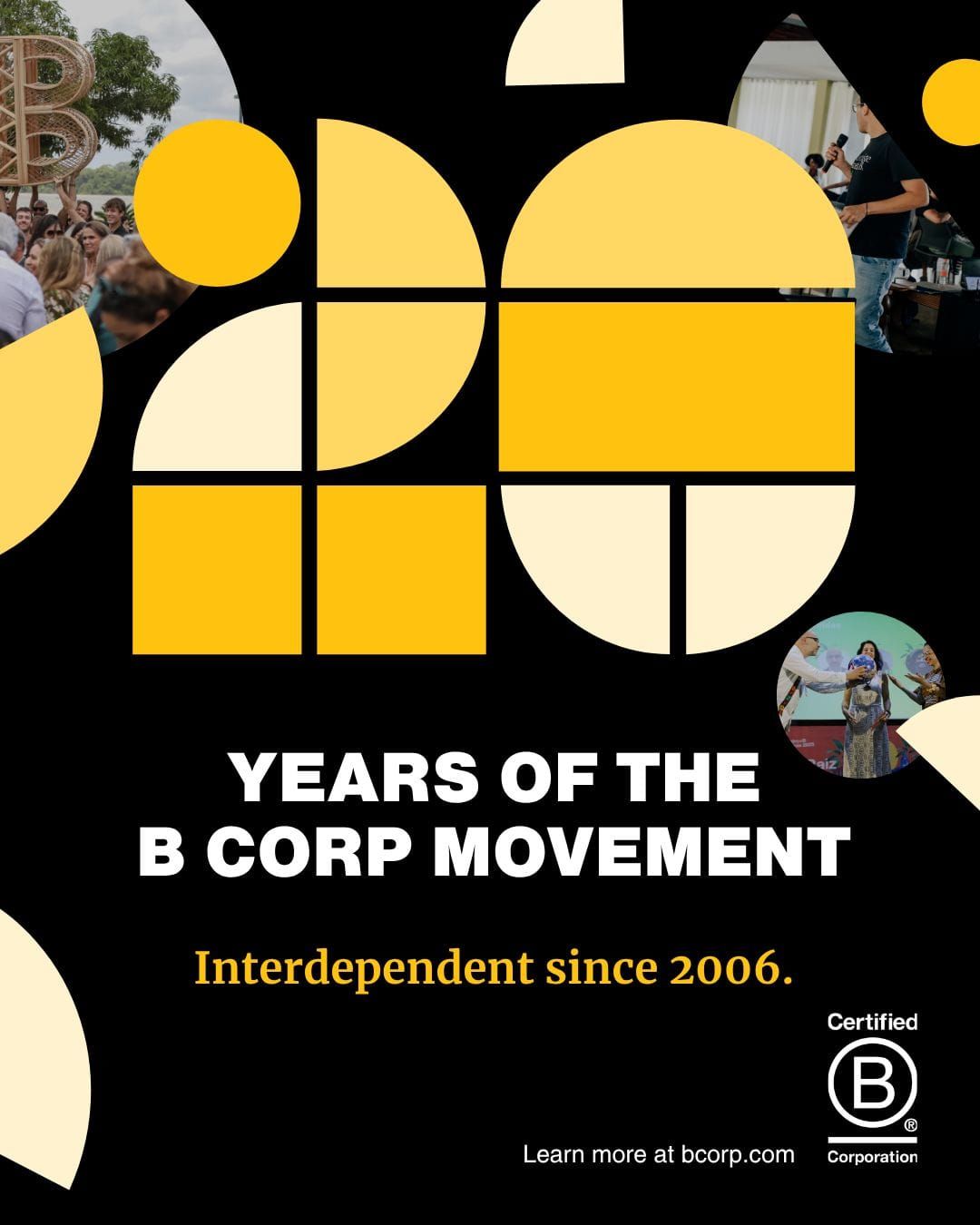
All of which is prelude to the commemoration of the 20th Anniversary of the B Corp movement as B Lab celebrates two decades since its founding in 2006.
And they’ve done it in bang-up style by producing a Special-Edition Impact Report (2006-2026).
The impact report has an engaging, fluid design, kind of like a patchwork quilt that makes the various panels fun to reveal. I’m generally a fan of simple, straight-forward web design, but for some reason this mosaic approach works for me.
As for content, there’s lots of looking back counterbalanced with the road ahead, with plenty of charts and graphs covering impact metrics.
The report is divided into three sections:
- 2026: Where we are now
- 2006: How it began
- 2026: Where we’re going
A few things stood out to me:
- A new focus on collective action: I believe this has long been a missed opportunity for the movement, and I’m glad to see that B Lab is doing something about it. This emphasis includes the creation of a Collective Impact Fund, which allows B Corps to pool their resources to pursue change at scale. They’ve also launched a new award for the B Corp community, the Andrew Kassoy Award for Collective Action. (Quite a guy, quite a life: Andrew was a co-founder of B Lab – you can read more about his life here.)
- The role of institutional donors: As B Lab is a nonprofit, I was pleased to learn about the support of institutional donors. While most of B Lab’s revenue comes from programs – certification fees from B Corps, B Lab has raised more than $70 million in philanthropic support since 2007. It's heartening to see so many large funders buying into the idea of stakeholder capitalism.
- An interactive timeline that’s fun to explore: It's an easy way to dive into the key events in the growth of the movement.
- The broader influence of B Lab: While there are more than 10,000 B Corps, B Lab's impact goes far beyond that as nearly 300,000 users have explored the B Impact Assessment – whether to become more educated about it or to employ its components into their own corporate journey of sustainable business.
I don’t need to blather on more about it. It’s worth the read and deserving of a bookmark as a resource if you frequently need to look up “many things B Corp” as I often do. So, do yourself a favor and check it out.
Godspeed, friends.
Russ
🤔 Think About It
"Consumers aren't going to solve these problems. Business will have to." James Surowiecki, Fortune magazine
💥 Quick Hits
Congrats to my friends Maiya Holliday, Andrew Boardman, and the team at Mangrove Web Development for joining the 1% for the Planet community – companies that donate 1% of their top-line revenue to environmental nonprofits. That makes Mangrove an esteemed member of the (informal) B1 group – companies that are both B Corps and 1% for the Planet members. Now that's commitment! So, if you're ever looking for smart help on accessible websites from a team that's future-forward on technologies and business practices, give them a shout!
It's Trivia Time!
Okay, we're not going to make this multiple choice, you'll just have to wrap your head around it and give it your best guess, with the answer revealed at the end of this issue.
What is the average amount that a U.S. worker has saved for retirement?
Are You Constantly Seeking Proof?
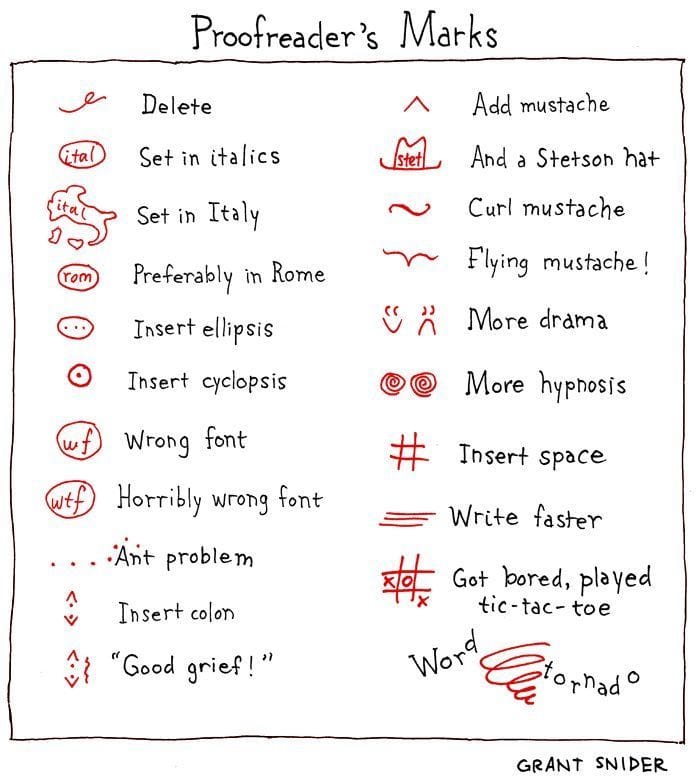
Anyone who's practiced the lost art of proofreading should get a kick out of this – surfaced for our enjoyment on Sara Rosinsky's LinkedIn page.
Trivia Answer
The average amount a U.S. worker has saved for retirement is $955. How close were you? Now let that sink in for a minute when you're thinking about our country's future. Source: Harper's Index/National Institute on Retirement Security.