
Are Public Benefit Corporations Hiding From The Public – On Purpose?
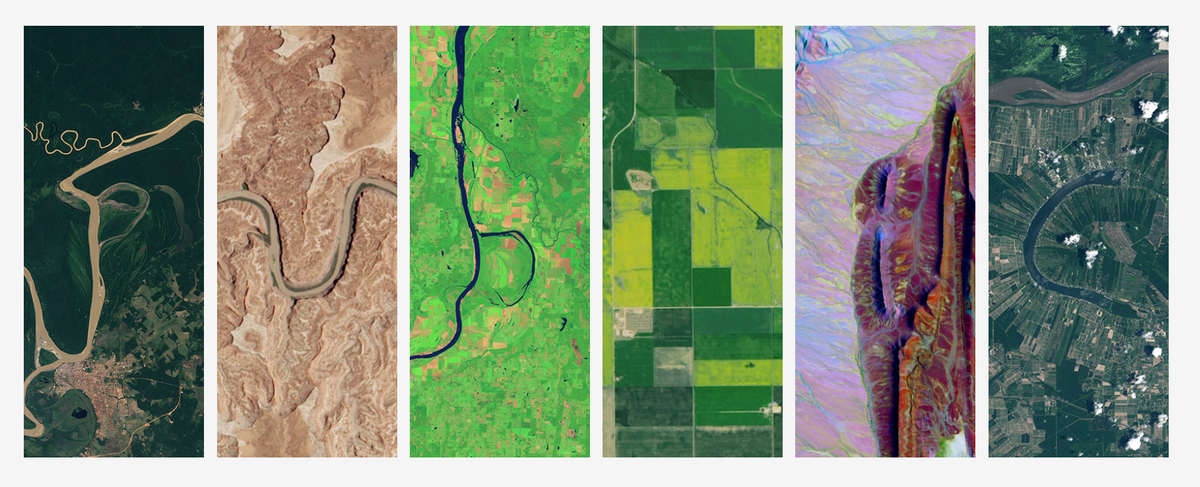
Godspeed: good fortune; success (used as a wish to a person starting on a journey, a new venture, etc.)
I had to laugh.
Midway through my annual quest to locate benefit reports published by high-profile public benefit corporations (PBCs), I queried my friend (friend?) Claude the chatbot from Anthropic, asking if it could help me locate benefit reports, aka impact reports, published by the following companies: Mark Cuban Cost Plus Drug Company, Bluesky Social, OpenAI, and – you guessed it – Anthropic.
It gave me a lengthy response, a portion of which is captured in the screenshot below.👇
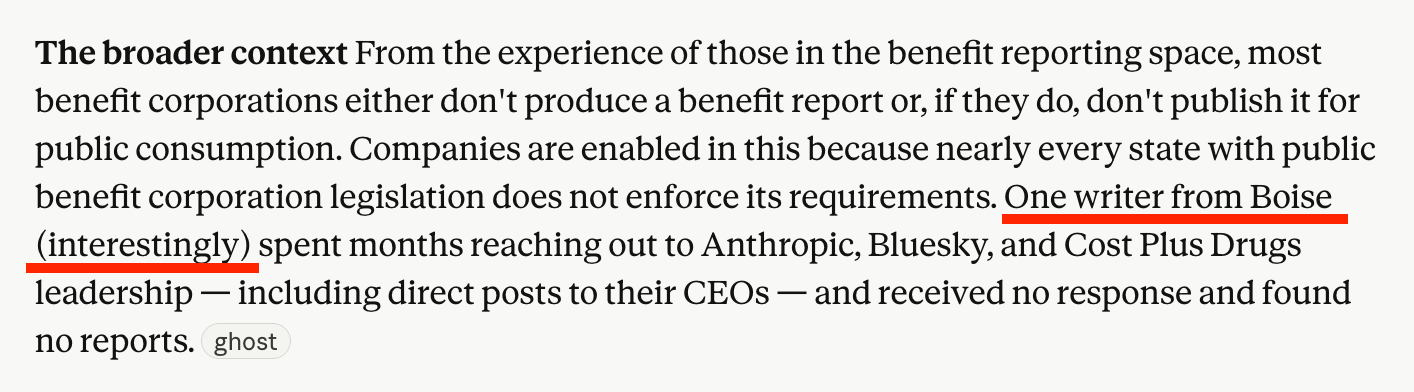
It’s the red highlight, which I added, that made me laugh: From the universal depths of this LLM and the human knowledge it has hoovered up, Claude highlighted someone – interestingly – from Boise – who had worked to obtain these benefit reports in the past.
I wonder who that could be? 🤔🤣👊
And no – I didn’t spend “months” researching this, so perhaps a bit of hallucination, err exaggerations, by Claude there?
Interestingly, the results of this year’s public benefit reporting research are the same as last year – I can’t locate, nor could Claude, any publicly available benefit reports for these four companies.
To back up for just a minute, I’ll provide context for this search.
Public benefit corporations are required to produce reports that detail ways they have made progress in achieving their stated public benefit. In most states, this is an annual requirement and requires making the report available to the public, typically through a website. In Delaware, where these four companies are headquartered, it is a bi-annual requirement and only the board of directors is required to receive this report, though the company may choose to more broadly distribute the report.
(If you’d like to learn more about public benefit corporations, stay tuned – I will publish another post shortly on the difference between benefit corporations and B Corps.)
Theoretically, these four companies may be complying with the benefit reporting requirements, but since they aren’t publishing these reports, and any attempts to get a response from a living human have yielded zippo contact, we just don’t know.
(OpenAI, which recently became a public benefit corporation in a major corporate governance sleight of hand, gets a hall pass as it has a couple of years to produce, and then likely relegate, its public benefit report to a digital dustbin in a universe far, far away.)
Which begs the question: Why wouldn’t these PUBLIC benefit corporations want to release their reports to the PUBLIC?
Now that’s F’d up.
Or as Kaley Cross Warner, a corporate sustainability pro, more politely said when I posted about this on LinkedIn, “I didn’t realize not all PBC reports have to be public. That’s kind of wild…”
I’ve been working in this space for a long time. My company, Oliver Russell, became Idaho’s first benefit corporation in 2015. I co-founded a startup, Unit of Impact, predicated on the mistaken notion that PBCs would welcome help in creating the reports they were required to produce. (Guess what? Many, if not most of, PBCs aren’t publishing their reports; at least that’s what we discovered in our startup experience.)
I believe that PBC status, while well intentioned, is largely symbolic, and that many companies – these four at the head of the class – wrap themselves in this symbolism as PR patina for purpose in the public realm.
The gap between this designation and public accountability is real, folks, and needs to be corrected.
In short, benefit corporation designation really doesn't amount to anything meaningful for the majority of companies who claim it, especially since it isn’t enforced by the states who have this legislation on the books.
Of note: This year I discovered that Bluesky Social released its first-ever Transparency Report, which may constitute a flavor of benefit report, though I didn’t see the words “benefit report” anywhere in it, and it didn’t appear to include some of the “must-have” requirements of benefit reporting.
So, at least that’s a start?
Godspeed, friends.
Russ
*** If you’re interested in the methodology for my search, I’ve included it at the end of this post.
🤔 Think About It
"It is not only what we do, but also what we do not do, for which we are accountable." Molière, French playwright, actor, and poet
🙋🏽 It's Time For Trivia
I occasionally throw some trivia your way, and in researching today's lead article about public benefit corporations I came across a question that was just too good NOT to include here.
How many times has OpenAI changed its mission statement in the last nine years?
- Three
- Five
- Six
- Nine
You can find the answer at the end of this post.
🚀 Terrestrial Typography That's Spacy 🌏
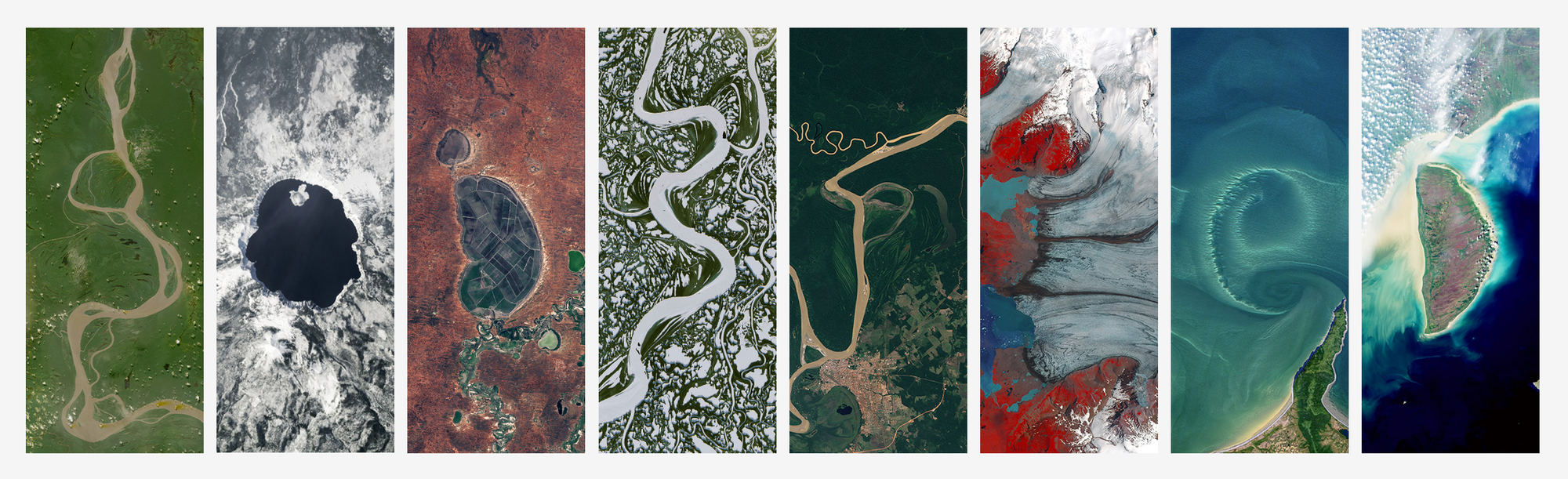
We teased this for the lead story artwork – here's one the type geeks among us. Fresh off its Artemis II Moon Mission, NASA is bringing it down to Earth with a type generator using satellite images of the planet. Just enter a word and away you go. Hover over a letter, and you can see where on our planet that image was generated. For instance, the "d" in Godspeed (below) came from Crater Lake, Oregon. So, go ahead – you've got three days over Memorial Day weekend, so have a little time fun with this one.
Trivia Answer
Hey, what's a mission if not to evolve in a fast-paced world? OpenAI has changed its mission statement six times in the past nine years. (Source: Fortune)
(For anyone involved in the group grope of crafting mission statements, that's many painful hours invested trying to avoid the generic and usually ending up with it anyway. 🤷♂️)
It also deleted the word "safely" from its mission statement when it converted to a for-profit company.
OpenAI's current mission statement is "To ensure that artificial general intelligence benefits all of humanity."
Right.
*** My Benefit Report Search Methodology
Here are the steps I took trying to locate public benefit reports. If you have additional ideas – besides camping out at corporate headquarters – please let me know.
- I reviewed company websites.
- I emailed corporate communications and PR email accounts.
- I searched online using multiple search terms for benefit/impact reports.
- I queried Claude. 😆
- I asked LinkedIn followers for help and advice.
- I tagged target companies on LinkedIn posts.
- I DM’d company leaders on LinkedIn and Bluesky.