Is Seeing Actually Believing?
I came across a news article recently that mentioned a partnership between Google and Range Media Partners to jointly produce content/movies. The partnership, 100 Zeroes, will focus on making microdrama content.
Range Media Partners – founded by a group of big-time talent management agents – brings artists and connections to the collab. You won’t find out much by going to Range's website, as it’s as spare and spartan as a website gets. Kind of a "Don't call us, we'll call you" vibe.
Google, I assume, brings financing to the partnership. My question is, what influence does Google have over the content of these projects, because – as the kids would say – this feels a little, no, a lot, “Sus” to me.
So I decided to sleuth around a bit, and you know what? Our friends at Google, who are invested in AI up to their eyeballs (which becomes more important later – read on), are somewhat transparent about their intentions here.
“Oftentimes, you’ve seen technology represented onscreen in a way that is intentionally making a point that may just be a bit misinformed,” said Jonathan Zepp, Google’s head of entertainment content and platforms, in a New York Times article.
“The world is changing quickly,” continued Zepp. “Technology is enabling that change, and it’s in all our interests, I think, from a societal perspective, for that story to be told accurately, authentically.”
“A bit misinformed…”
“It’s in all our interests…”
I love the way he and Mama Bear Google are wrapping us all in a big hug of intentions born of accuracy and authenticity.
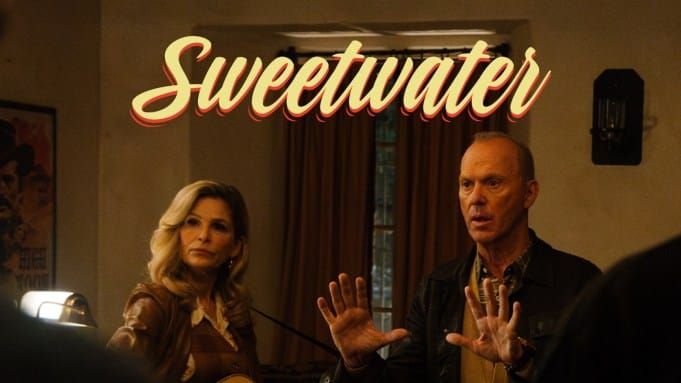
One of the first fruits of this partnership was last year’s production of Sweetwater, a short film, err, microdrama, that positions AI in a softer, positive light.
The film features Michael Keaton (who also directs) and Kyra Sedgwick. In interviews, Keaton and Sedgwick said all the right things (concerned by AI, happy to be an actor playing AI rather than the other way around), though I’m guessing at the heart of this acting decision was oodles of money for the pair.
As for Keaton’s take on AI? “You don’t replace anybody in the industry. I’m very old-fashioned about people and employment and work and being protected,” Keaton said in a Los Angeles Times interview. “And at the same time, I find this stuff really interesting and curious.”
I wonder if he knows he’s eating his own tail, and how he’ll feel when he reaches the tasty internal parts just before he arrives at his neck?
The film was penned by Keaton’s son, Sean Douglas, which adds its own interesting layer of family complexity.
I've had business dealings over the years with Hollywood and Silicon Valley. Hollywood is just plain weird. And Silicon Valley is weird times 2. What a marriage!
Speaking of Hollywood: It’s having its way with Silicon Valley right now, with unflattering releases depicting Mark Zuckerburg (The Social Reckoning), Elon Musk (Musk), Elizabeth Holmes (You Can See Everything), and Sam Altman (Artificial).
So, as a brand strategist, I get it – While these movies raise uncomfortable questions with power-drunk characters, Google wants to put its best foot forward. But shouldn’t movies like Sweetwater contain a content warning, much like when NPR airs a story and appends a message alerting the listener that a company mentioned in the story is a sponsor of NPR?
Perhaps something like, “This movie was funded in part by Google, which has a vested interest in the market success of A.I.?”
Okay, yes – I know that Amazon, Apple, and others are involved in creating media content. But they apply their names to the product, while "100 Zeroes" slips itself away from a clear declaration. A bit sneaky.
(And we'll save media titans Larry and David Ellison, Jeff Bezos, and Laurene Jobs Powell for another episode.)
I’m not so naïve as to believe this is Google’s first foray into the netherworld of power building and influence peddling, but this one feels slimy to me. It’s no wonder trust in institutions is at an all-time low.
Whatever happened to the company whose motto once upon a fairytale time in Mountain View was “Don’t be evil”?
Godspeed, friends.
Russ