The Future of Work

Godspeed: good fortune; success (used as a wish to a person starting on a journey, a new venture, etc.)
Editor's note: This week I'm turning the steering wheel over to my B Corp and 1% for the Planet colleague Janice Stevenor Dale. I've known Janice for a number of years now, and she's just so stinking smart – it's always interesting and instructive to hang with her and talk about her soothsaying expertise, the future of work.
Janice heads up J S D A Inc, a design firm operating at the intersection of sustainability, innovation, and cultural stewardship. While her firm is headquartered in Los Angeles, Janice lives and practices here in Boise. (See, I told you she was smart.)
As I now run a coworking space with lots of remote workers who bounce back and forth between my space and their homes, I get to see this "flexibility" at work on a daily basis – and the valued tether it provides to employers and their talent.
Godspeed, friends.
Russ
Why Flexibility Is Becoming the Business Imperative
For a century, the traditional Monday through Friday, 9-to-5 workweek defined organizational life. But that model has shifted significantly—not singularly influenced by employee preference, but driven by economic opportunity, sustainability, technology, and data.
Stanford economist Professor Nick Bloom, one of the world's leading researchers on the future of work, has released the results of new research demonstrating that the debate is no longer simply about whether hybrid work reduces productivity. His research shows that employees working in hybrid arrangements perform just as well as their office-based peers, while experiencing significantly lower turnover.
As Bloom summarized, "Hybrid WFH reduced quit rates by one third," adding that organizations ultimately discovered that "hybrid works well."
Retention matters because replacing skilled employees is extraordinarily expensive. Bloom notes that organizations have estimated replacement costs ranging from 50% to 200% of annual salary when recruiting, onboarding, lost productivity, and knowledge transfer are considered, depending on the employee's role. In other words, any perceived productivity gained through rigid return-to-office mandates can quickly disappear if valued employees simply leave for more flexible employers.
At the same time, organizations are taking a new approach to real estate assets on their balance sheets. Class A office space in major North American markets commonly costs well over $300 per square foot annually on a fully loaded occupancy basis when rent, taxes, utilities, maintenance, security, technology, and operating expenses are combined. Yet real estate remains only the second-largest organizational expense. Employee compensation and benefits typically represent the largest share of operating costs, identifying talent—not buildings—as the primary investment requiring optimization. Talent is a collective now, balanced with AI, with its own set of costs.
The sustainability implications are equally compelling. Millions of daily commuters consume fuel, increase congestion, require roadways, and generate unnecessary carbon emissions purely to perform work that technology now enables from virtually anywhere. Employees heat or cool largely vacant homes simultaneously while employers heat and cool partially occupied office buildings throughout the year—a duplication of energy consumption that runs counter to ambitious corporate ESG and net-zero commitments. Collectively, we all absorb rising fuel prices, vehicle costs, parking expenses, and hundreds of hours of lost in personal time each year commuting.
These realities are especially important culturally to younger generations entering the workforce. Millennials and Gen Z increasingly evaluate employers based not only on compensation, but also on autonomy, flexibility, purpose, and quality of life. Work is becoming a fluid, integrated component of life—not its defining constraint.
Looking ahead, AI, robotics, and intelligent digital assistants will continue automating repetitive administrative work once performed by people.
Moderna, the innovative pharmaceutical firm, reported in May 2025 (Wall Street Journal) that it had partnered with OpenAI, creating 3000 bots. Rather than viewing this as a threat, forward-thinking organizations recognize it as an opportunity to elevate human work toward creativity, innovation, strategic thinking, and relationship building.
The competitive advantage will belong to organizations agile enough to redesign workplaces to provide for outcomes rather than attendance.
As we plan for optimum workspace, we are long past choosing ‘between’ office and home; working ‘about’ might be the proper descriptor. Work is everywhere–during travel, at lunch, at the ballpark, evenings and weekends, and in data centers, continuous. Conventional wisdom encourages us to plan organizational workspace that maximizes human/work potential while capturing unnecessary cost, minimizes environmental impact, and avails organizational fluidity. Organizations that embrace agility thoughtfully will not simply retain better talent—they will actively position their organization to thrive in an economy increasingly shaped by climate and energy concerns, AI, and continuous technological change.
Connect: If you're interested in following the "future of work," you can connect with Janice on LinkedIn or listen to her podcast, DesignIDEATE.
🤔 Think About It
“If you have a chance to accomplish something that will make things better for people coming behind you, and you don’t do that, you’re wasting your time on this Earth.” Roberto Clemente
💥 Quick Hits
- The quality of impact reporting by benefit corporations – Using a hybrid human/AI model and the population of benefit corporations in Minnesota, David S. Lucas, Clara Scheve, and Joel Gehman introduce a new model for determining the quality of benefit reports. Definitely worth a look if you're involved in impact reporting or run a benefit corporation.
- "This company has a soul" – And Eddie Smith Jr., the owner of Grady-White Boats, didn't want to lose that in an ownership transition, so – inspired by Yvon Chouinard of Patagonia – he forwent as much as $400 million and steered his company into a purpose trust.
- Speaking of "steering" – If you'd like to steer more of your purchasing power to companies that are worker owned, check out this new marketplace.
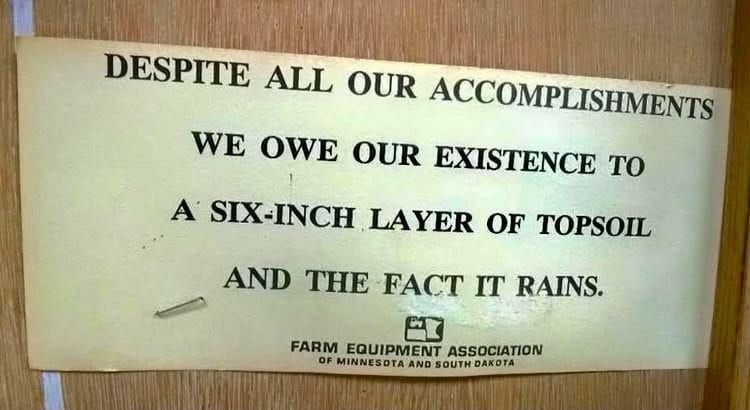
And Finally: A Dirty Message From the American Plains